How to Cast On in Hand Knitting
First Hand Knitting Project for our Little Knitters Program is the Fun and colorful Doctor Who Season 12 Striped Garter Stitch Scarf.
Hand Knitting Instructions by Sharon Nani / The Knit Tree
Photos by David Nani
© 2008
Hand Knitting begins by making a Slip Knot and Casting On the required number of stitches for your project. This is part Two of the Basic Hand Knitting Techniques Series which takes you through Photo Steps Instructions of how to Cast On Stitches for Hand Knitting.
Our First Hand Knitting Project for our Little Knitters Program is the Fun and colorful Doctor Who Season 12 Striped Garter Stitch Scarf. We also offer Pure Wool Yarn Kits for this scarf which can be knit as the original Dr Who Scarf which is 15 feet long, or you can knit 2 scarves 7.5 feet long, or knit three great gifts of gentlemen scarves each 5 feet long, from this yarn kit.
Read about the entire learning process of the Little Knitters, taking them through researching to find and buy the correct yarn and colors for this Fan Based Knitting Project, drafting the knit pattern, learning the knitting techniques, then knitting this scarf for their Knitting for Charity Challenge. Click here to read Doctor Who Season 12 Scarf Knit for Charity ChallengeYou may even find a finished Doctor Who Scarf available for purchase with proceeds donated to The Leukemia & Lymphoma Society and The Little Knitters Program.
NOTE:Click on all images to see an enlargement of the photo!Steps of Casting On a Knit Project with Photos
Hand Knitting Starts with the Cast On
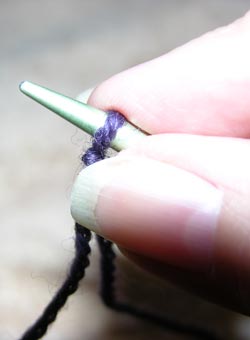
Photo ofThe first step of a knit cast on begins with a slip knot also known as a slip loop
The first step of a knit cast on begins with a slip knot also known as a slip loop
We share these knitting instructions with you so you can also learn to knit with a fun and colorful knit project. Enjoy knitting with your own yarns or you can purchase the pure wool yarn kit with Spreadsheet Knitting Chart from our online Catalog for the Season 12 Dr Who Scarf. Print out the series of instructional articles from our web site to aid in your learning to knit process
Hand Knitting begins by Casting On. The First Step of the Cast On is to make a Slip Knot or Slip Loop. Click here to see Detailed photos of How to make a slip knot which is Part One of our Series on Basic Hand Knitting Techniques.
Figure 1. The first step of the cast on begins with a slip knot or loop. This is stitch number one of the cast on.
What to Do With the Right Hand
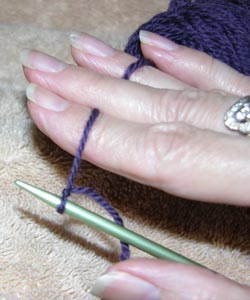
To begin knitting the cast on the yarn is woven between the fingers to create tension on the yarn
Figure 2. Place the knitting needle between your thumb and first finger. The slip knot is near the point of your needle. You will hold the knitting needle as if you were holding a pencil. At the same time, weave the ball end of yarn over the first finger, under the second, over the third, under the fourth above the middle joint and finally under the baby finger. Some knitters actually wrap the baby finger with the ball yarn to keep tighter tension. You will find what is comfortable for you.
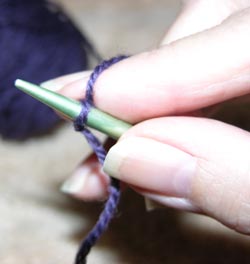
The right hand holds the knitting needle like a pencil with the index finger pressing against the stitch for control
Figure 3. This is how you are holding the needle with your right hand and the yarn has been woven around your fingers. Notice that your first finger can press against the stitch that you are working with. This gives you control.
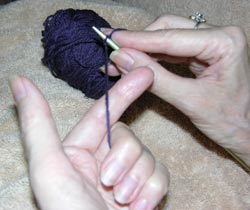
Grasp the free end of the yarn lightly against the left hand with the second, third, and fourth baby finger. This is the yarn that you measured off when you created the slip knot.
Figure 4. Grasp the free end of the yarn lightly against the left hand with the second, third, and fourth baby finger. This is the yarn that you measured off when you created the slip knot.
What to Do With the Left Hand
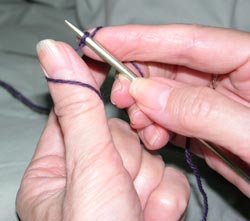
Place the yarn near the knitting needle, around and under the thumb of the left hand
Figure 5. Place the yarn near the knitting needle, around and under the thumb of the left hand.
Now you are Ready to cast on the remainder of the stitches required for your knitting project.
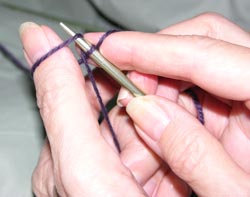
Notice the loop of yarn around the left thumb. With your right hand, insert the knitting needle through the underside of this loop
Figure 6. Bring the hands close together, making sure the tension is adjusted for the yarn. The wrapping of the yarn on the right hand (Fig. 2) and the grasping of the yarn with the left hand (Fig 4) along with the placement of the yarn around the thumb of the left hand (Fig. 5) all work together to create the correct tension.
Notice the loop of yarn around the left thumb. With your right hand, insert the knitting needle through the underside of this loop.
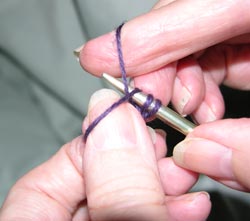
Figure 7. With your first finger of your right hand – which is holding the ball end of yarn – bring the yarn over the point of the needle from the back.
Figure 7. With your first finger of your right hand – which is holding the ball end of yarn – bring the yarn over the point of the needle from the back.
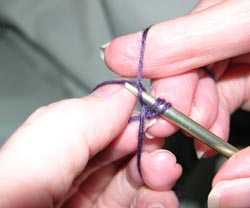
Moving the knitting needle toward you, draw the yarn through the loop of yarn on the left thumb
Figure 8: Moving the knitting needle toward you, draw the yarn through the loop of yarn on the left thumb
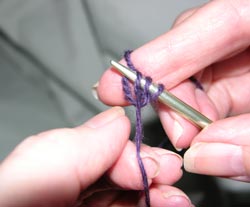
Pull your thumb out of the loop of yarn, leaving a loose cast on stitch on the knitting needle.
Figure 9. Pull your thumb out of the loop of yarn, leaving a loose cast on stitch on the knitting needle.
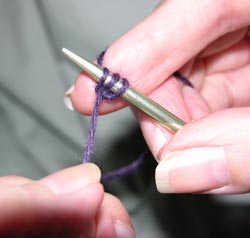
Gently pull the free end of yarn with the left hand to tighten the stitch which was just cast on.
Figure 10. Gently pull the free end of yarn with the left hand to tighten the stitch which was just cast on. Pulling the yarn to a consistent tightness around the different needle sizes is what will create your stitch and row gauge (how many knitted stitches are in 1 inch and how many knitted rows are in 1 inch).
Repeat steps in Figures 5-10 until you have all the stitches cast on for your project. In our sample knitting project, this would be 60 stitches.
The Cast On Row is not normally counted as a Knitted Row for your Pattern Instructions. We do not count it in our Dr Who Scarf. Although some knitters count this row as the first Garter Ridge when they are knitting a project in Garter Stitch. To keep our project simple and our Garter Stitch Pattern Count in multiples of two even rows, we do not count this cast on as a Row of Knitting in our Doctor Who Scarf hand knitting instructions.
It is important that you knit a swatch first to make sure that you are using the correct needle size to obtain the stitch and row gauge to match the knitting instructions of your pattern. This knitting swatch is discussed in our article which goes through all the steps of our first knitting project "Learn to Knit by Hand or Machine “Doctor Who Season 12 Scarf Knit for Charity Challenge”.
Knitting Lesson One ~ the Season 12 Doctor Who Garter Stitch Scarf Replica
Hand Knitting Techniques used in Knitting Lesson One: Doctor Who Season 12 Knit Garter Stitch Striped Scarf consists of Several Parts, all with Photo Instructions for each step: Continue on with Your Basic Hand Knitting Techniques for Lesson One
- Basic Hand Knitting Techniques Part 1: how to make a slip knot to begin,
- Basic Hand Knitting Techniques Part 2: then cast on the required number of stitches
- Basic Hand Knitting Techniques Part 3: how to knit the knit stitch; garter stitch just consists of two knit rows
- Basic Hand Knitting Techniques Part 3: how to change colors in knitting for different colors of stripes when knitting garter stitch
- Basic Hand Knitting Techniques Part 4: how to bind off.
- Basic Hand Knitting Techniques Part 5: Finish Knitting: how to weave in the ends of yarn colors at the changing points
- Basic Hand Knitting Techniques Part 5: Finish Knitting: how to attach tassels
- Basic Hand Knitting Techniques Part 5: Finish Knitting: how to steam lightly and hand press
This is just one way to Cast On in Hand Knitting. We use this knitting technique in our first Lesson for Beginning Hand Knitters. It is used in our knitting instructions for the Doctor Who Season 12 Knit Garter Stitch Striped Scarf. Find the Pure Wool yarn Kit for this scarf in our online knitting catalog.
Click Here to Return to the Main Article : Learn To Knit by Hand or Machine ~ Doctor Who Season 12 Scarf Knit for Charity Challenge to follow the entire Little Knitter Experience of Researching and Developing a Knit Project!
Look for our Knit for Charity Challenge Doctor Who Season 12 Scarves ~ hand knit or hand loomed in Garter Stitch with Nature Spun pure Wool in The Knit Tree’s One of a Kind Showroom
If you do not find any available, contact customerservice for information and to get on our waiting list.
Visit us on facebook too ~ page is in development